Showing posts with label scones. Show all posts

Monday, October 8, 2012

best ever cheese scones


So here goes, you taste scones at Le Cordon Bleu cooking school (see here) and they're the best cheese scones you have ever tasted.  Everyone around you agrees so you really have to try these at home, don’t you?  Problem was I had no recipe, only a few hints and clues hastily scribbled on my iPhone. (Can you scribble on an iPhone? Yes, I think you can ‘cos it has a font that looks like handwriting.)

In my first attempt, finding the right mix was like playing Cluedo.  Was it the plain flour with the cheese in the kitchen?  No?  Perhaps the self-raising flour with the salt in the parlour?  Good job I like Cluedo.  I may not have got all three answers in the bag but I was pretty pleased with the result. I have to admit it took me five scones to figure that out.  In my defence, they were small ones.


For the second trial, I used guinea pigs in the form of two strapping lads who came inside for a coffee break after digging up the garden beds (with my permission, I might add).  This time I’d tweaked the recipe by changing the plain flour to self-raising and adding more cheese.

I have good news and bad news.  The good news is that I only ate three scones this time.  The bad news is that they were bigger scones.  I know, it’s only bad news for me.  

The even better news is that they worked.  The boys were happy, I was happy and maybe you could be happy too if you just try them, who knows?  They may not be 100% as gorgeous and perfect looking as Le Cordon Bleu’s but I think they’re still a winner. 

The secret, I think, is to:
  •  use lots of cheese (I used Vintage* cheddar)
  •  have a wet dough
  •  handle the dough as little as possible
If you make them slightly smaller, like the first batch, you don’t even need butter.  They are simply yummy! 


Best ever cheese scones

2 cups self-raising flour
¼ teaspoon salt
50g cold butter
2/3 cup cheddar cheese (I used Mainland Vintage*)
1 cup milk
extra cheese to top the scones

Heat the oven to 230°C (450°F).

Sift the flour and salt into a mixing bowl.  Either grate the chilled butter into the mix or cut it into small dices.  With your fingertips, rub the flour and butter together until it resembles breadcrumbs.  Stir in the cheese.

Mix the cup of milk in lightly and quickly using a knife or palette knife until it just forms a dough. Do not overmix.  The dough will be quite wet at this stage.

On a lightly floured board and with floured hands, gently roll the dough into a long cylindrical shape and shape into an even thickness.  If the dough feels too sticky, put a little more flour on the board and your hands – just enough to continue. Cut into rounds, big or small, and place them on a greased oven tray or a tray lined with greaseproof paper. 

Grate some extra cheese over the tops of the scones – I like to use a reasonable amount.

Place the tray near the top of the oven.  Bake for 10-15 minutes until the scones are golden brown.  Remove to a cake rack and cover with a dry tea towel to keep warm.  Serve as is, or with butter.

Best eaten warm on the day – believe me they don’t last long.

* Mainland Vintage is an aged cheddar with a crumbly texture and real bite.

For a sweet alternative, click here for cranberry & custard scones


Tuesday, September 18, 2012

Welsh cakes


Welsh cakes have been described as a cross between a fruit scone, a pancake and a biscuit (someone said shortbread) – and rightly so - but they have a unique taste of their own.  I can't think of anything that quite compares to them.  

Some time ago a colleague baked them one day for morning tea. Her perfectly crimped little rounds were a taste from her homeland of Wales.  I liked their simplicity, their scone-like texture, the burst of juiciness when I bit into a sultana and the sweet sugar on top.  

Well I won the Welsh test, which is not to say I am now a one-woman rugby team, but that I apparently turned out a pretty good result at my first attempt at baking them last weekend.  I took some to work on Monday and handed the Welsh one hers.  She scoffed it down with obvious delight and declared it "lovely".  She's either very diplomatic or they were very good.  Either way, I don't care.  I Iiked them so that's all that needs to be said.

These are so very simple to make so one day, when you want a change from scones or muffins, try them.  Enjoy them still warm and unadorned (except for the sprinkly sugar topping)  or with butter and jam.  My preference though is to eat them one or two days old when they are firmer and seem to have more taste.  


Welsh cakes


225g/8oz self-raising flour, sieved
110g/4oz salted butter
50g sultanas
1 egg, beaten
milk, if required
85g/3oz caster sugar
extra butter, for greasing

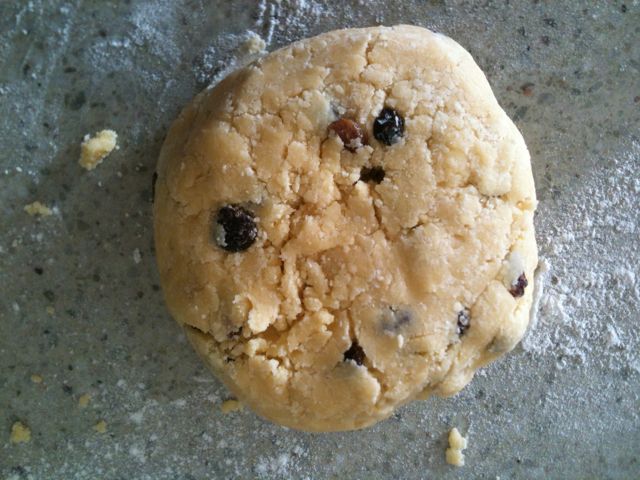
Rub the fat into the sieved flour until it resembles breadcrumbs. Add the sugar, sultanas and then the egg. Mix to combine, then form a ball of dough, using a splash of milk if needed.

I just want to pick out all the sultanas at this stage!

Roll out the pastry until it is a 5mm/1⁄4in thick and cut into rounds with a 6cm/2-2 1/2in fluted cutter. (Fluted is traditional, you can use a plain round cutter if you wish.)

If you have an old-fashioned griddle, this is ideal (I don’t, although we used to have one back home in Scotland).   Otherwise, use a heavy bottom frypan and start heating it up.  I used my Le Creuset frypan and will be using it until I’m old and frail when I won’t be able to lift it.  Smear a little dab of butter on a paper towel and rub it over the base of the frypan.  Place the Welsh cakes on the frypan and cook for 2-3 minutes each side until brown.  You may have to cook them in batches so repeat smearing the pan with butter as necessary.

Remove from the frypan and put the cakes inside a tea towel on a plate to keep warm.


While the cakes are still warm, dust the tops with caster sugar.  Eat and enjoy.


Saturday, January 7, 2012

apple butter with sultana scones


It’s amazing how relaxed I am feeling after the assault of Christmas.  It shouldn’t be like that but it was and it is.  I swear I will do it differently each year but it always ends up the same – stress, stress, and more stress.  Enough.

In the oh so wonderful aftermath of rising late, pottering around and having the time to indulge, I am finally finding the peace again. 

Midweek, I made the decision to make sultana scones for breakfast instead of eating breakfast AND then baking AND eating scones for morning tea.  Yes, this is what I call post-Christmas lean eating!  There was a reason.  I have wanted to make apple butter for a long time and I have wanted to participate in Cookbook Sundays, since Sue at Couscous and Consciousness began hosting it a few months ago.  Two very good reasons.


I don’t know much about fruit butters. The first thing I learned was that apple butter does not contain butter.  The second was that I had imagined it would turn out to be a pale, apple sauce-type spread but it was much darker in colour and had the texture of a smooth chutney.  (It was supposed to be the consistency of room temperature butter but my effort was not quite as thick as that). 

Whether or not my first attempt was any good, I liked it.  I imagine it would go well with a good sharp cheddar cheese or a Brie, or served with cold meats especially ham and pork.  It kind of reminded me of a softer, runnier, more intense version of fruit paste. On the sweet side, it could accompany waffles or pancakes or, as I found, scones.  Versatile then.  I am sure some of you reading this will have lots of ideas on pairing apple butter and other fruit butters and I would love to hear some other ideas.


When I was trying to think of how I would eat it, I thought of the taste of stuffed, baked apples and came up with the idea of pairing the butter with sultana scones and I think it works.  Well, you know, it worked for me.

The recipe comes from a book The New Vegetarian Epicure by Anna Thomas, which I bought in Taranaki (New Zealand) many years ago and I am almost sure I have not cooked anything from it.  The bookshop called Simply Read was in a lovely little red building down by the surf coast – a wonderful place to visit.  I am not vegetarian but I do enjoy trying different recipes using vegetables.

This is why Cookbook Sundays appealed to me.  Not just finding a cookbook that I have used seldom (or not at all) and testing a recipe, but finding new things to try and interacting with a wider audience to learn more.

I made a smaller amount of the apple butter recipe given and found that the liquid evaporated so I topped it up.  I have posted the full recipe below (maybe you need to use the full amount so it won’t evaporate!?). 

For the scones, I just used a basic recipe and added some sultanas so they’re really just a pairing up for the apple butter and did not appear in the same book.

The photographer was back at work so it was just me and the point and shoot camera. I had the time and that is part of the enjoyment.  To have the time to shoot the photos inside and if that doesn’t work, try outside.  To take the time to create the mood and style the photo.   To have no rush, except to eat the scones still warm from the oven with a dollop of spicy apple butter on top. Bliss.


Apple butter (makes just over 2 pints or 1.4 litre)
3 ½ lb/1.6kg tart green apples
16 fl oz/450ml apple juice
1 cup white sugar
1 cup brown sugar
½ tsp ground allspice
½ tsp ground cinnamon
¼ tsp ground cloves
1/8 tsp salt
2 tbsp molasses

Peel, quarter and core the apples but don’t discard the peels or cores.  Squeeze a little lemon juice on the quartered apples to keep them from browning. 

Place just the peel and cores in a saucepan with the apple juice and simmer gently for about 30 minutes.  Strain the juice and discard the solids.

Add the quartered apples and the remaining ingredients to the juice and simmer, stirring often, until the apples are very soft.  Press the mixture through a fine sieve or puree in a blender.

Continue cooking the apple butter over a low heat, stirring often, until it is very thick and smooth.  Spoon into hot, sterile jars leaving about 1/3 in/8mm of a gap between the mixture and the top of the jar, and seal.


Sultana scones
Makes about 8-10 scones

2 cups self-raising flour
2 tsp sugar
pinch salt

1¾ oz/50g butter, cold, diced finely or grated
½ cup sultanas
1 cup milk, approximately

Pre-heat oven to 230°C

Grease a baking tin or line a tray with baking paper.

 Sift the flour, sugar and salt into a bowl.

Rub in the butter with your fingertips until the mixture resembles fine breadcrumbs.  Add sultanas and mix gently to combine.

Make a well in the centre of the mix and pour in most of the milk.  Using a wide knife (I use a palette knife), mix together to a soft, sticky dough.  Add more milk from your measure if the mixture is not sticky enough.

On a lightly floured board or surface, gently knead the dough and press out to ¾ inch/2cm thickness.

Using a flour dusted cookie cutter or knife, cut the dough into desired shapes and place the scones close together (almost touching) on the tray or tin.  Brush the tops with a little extra milk.

Bake for 10-15 minutes until the tops are golden and cooked through – the scones should sound hollow when tapped with your fingertips.

Serve with some real butter and a dollop of apple butter.

Scones are best served warm and on the day they are made.  However they can be frozen. 

Friday, July 29, 2011

cranberry and custard scones


To think I could have been indulging in these scones for years – six to be exact.  For that is how long the recipe has been languishing in my folder.  Unused.  Unloved.  Until now.

I’ve passed over this recipe many times.  Not because they didn’t look lovely – large scones oozing with custard and drizzled with icing – but because I thought they’d be time consuming.  Whipping up a batch of scones is one thing, but custard and icing too?  Sigh … if only I’d known.

Well now I can confirm that this recipe takes scones to a new high.  My first taste – and I couldn’t wait to taste them – was like biting into a cross between a Danish pastry and a scone.  Seriously scrumptious.  The vultures thought so too.  The scones vanished in seconds. 

As well as mistakenly waiting too long to attempt them, I also erred in the amount I made.  I halved the recipe figuring three of us would not eat twelve scones.  Wrong.  Three of us would have eaten twelve scones.  Hell, one of us may have eaten twelve scones!  I swear they were that good.  The look on B’s face said the same.  If there is one piece of sage advice I can give you – I implore you to make lots!

The recipe was published in City Mix magazine in 2005 and came from the then chef, Katrina Smith of Craven “A” café, 4 Saint Paul St, Auckland (I believe the café is still there, not sure if the chef is).  The café is near the University of Auckland and I imagine masses of grateful students have hungrily demolished these.  A warning to Katrina – if you ever see me, run!  I feel I am going to be overcome with gratitude for this treat and plant big kisses on your cheeks!


cranberry and custard scones

Makes 12 scones

a handful of dried cranberries
3 cups standard flour
3 tsp baking powder
3 tbsp brown sugar
1 pinch salt
200g butter, diced or grated
milk
1 egg, lightly beaten
2 cups custard (make custard following packet directions)

Preheat oven to 220°C.

Place cranberries in a saucepan, add a little water and heat gently until cranberries are softened and water has evaporated.  Drain to remove excess water and leave to cool.

Make custard following packet directions (or use store-bought, chilled custard) and leave to cool (place in the fridge to cool down quickly if you are short of time). 

Mix the flour, baking powder, sugar and salt in a bowl.  Rub in the butter until mixture resembles fine breadcrumbs.  Add enough milk to form a soft, but not sticky, dough – use a palette knife to bring the mixture together.  Roll dough into a large rectangle and cut in half.  Brush both halves with the beaten egg.

Spread the custard over one half of the dough and sprinkle with the cranberries.  Place the other half of the dough on top.  Brush the top with beaten egg.  Cut into 12 pieces, place on a lined baking tray and bake for 20-30 minutes.

When cooled slightly but still warm, drizzle the scones with the icing, or you can glaze with hot jam or dust with icing sugar.